Poshan Maah Abhiyan 2026: Theme, Dates & Data Entry Guide
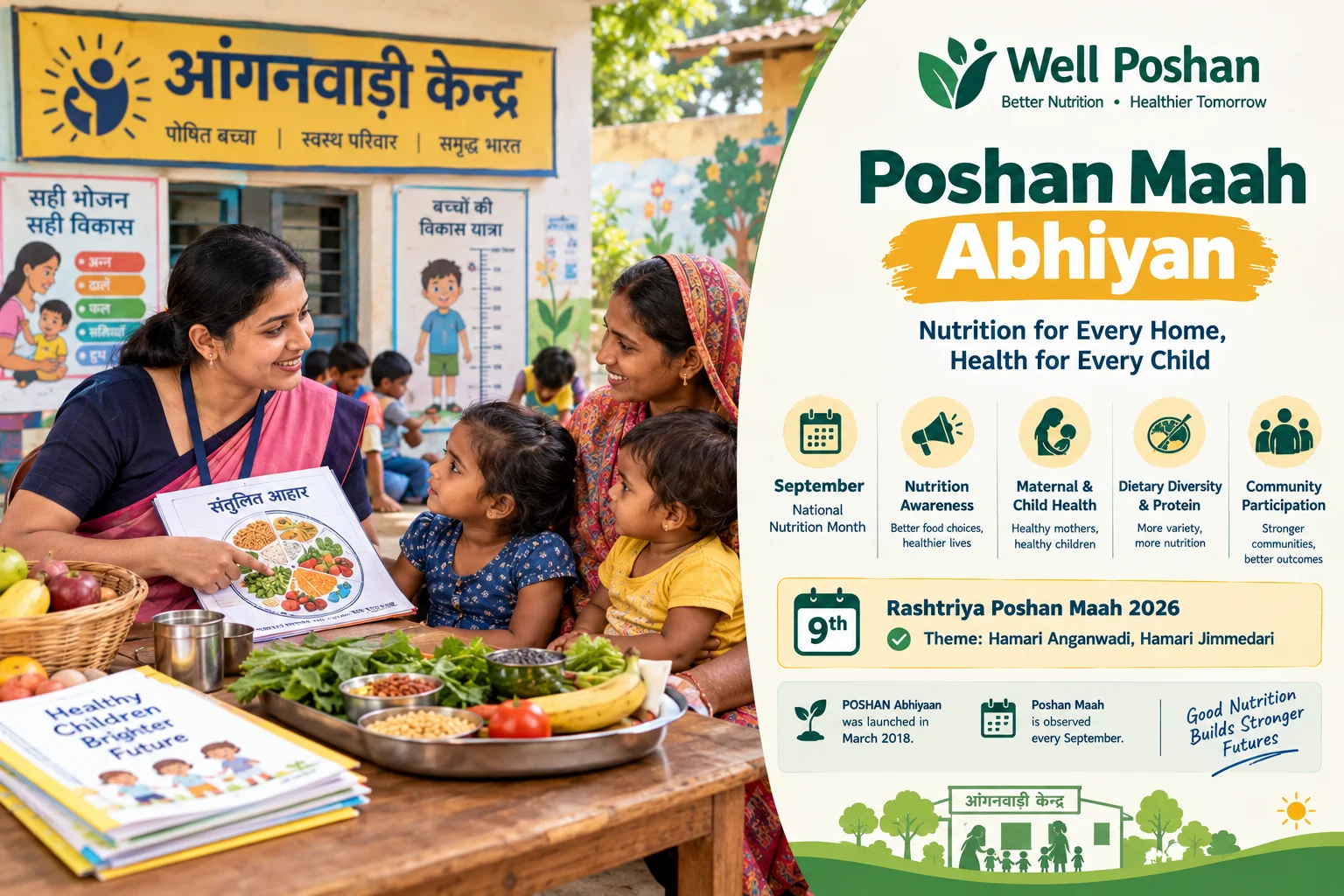
Poshan Maah Abhiyan is India’s month-long, every-September nutrition movement, and its 9th edition runs from September 9 to October 8, 2026, under the theme “Hamari Anganwadi, Hamari Jimmedari”.
That one line is the answer. The rest of this guide covers what’s new in Poshan Maah Abhiyan 2026, how to handle data entry without a month-end panic, and what the numbers say about whether the campaign works.
What Is Poshan Maah Abhiyan?
Poshan Maah Abhiyan (officially Rashtriya Poshan Maah Abhiyan, or National Nutrition Month) is the September campaign under Mission POSHAN 2.0. It places Anganwadi Centres at the centre of community-led nutrition, healthcare and early childhood development. Poshan Abhiyaan itself was launched on March 8, 2018.
The campaign is also a Jan Andolan, a people’s movement. The Jan Andolan approach comes from social and behaviour change communication, a method India has used for decades, with polio eradication and Swachh Bharat as its showpiece successes.
Why this matters: nutrition doesn’t improve because a poster exists. It improves when a grandmother, a panchayat member and a young father all change what lands on the plate. A Jan Andolan works because it makes the change social.
Poshan Maah Abhiyan 2026: What’s New This Year
The 9th edition was launched in Varanasi and draws on revised Supplementary Nutrition Programme guidelines that, for the first time, define Hot Cooked Meals and mandate SNP Menu Boards. It also puts Anganwadi Management Committees (AMCs) in the spotlight.
The 5 themes of Poshan Maah Abhiyan 2026
The five focus areas are dietary diversity and adequate protein, fresh hot cooked meals, community ownership and accountability, nutrition with early childhood development, and 10 years of PMMVY.
At least one AMC meeting is expected at every centre during the month. Poshan Melas and showcases of Poshan Vatika produce are also on the activity list.
Poshan Maah Abhiyan 2026 at a glance
If you’re reading this in the final days, log your pending activities now. More on that below.
Poshan Maah Abhiyan Data Entry 2026: Step by Step
Most people mix up two different systems, so start here.
Poshan Maah Abhiyan data entry (also called Poshan Maah Abhiyan Entry) goes into the first one.
The 5-step entry workflow
Heads-up: portal addresses and access rules can change between years. Always follow the link in your state’s current circular. The steps above reflect the MoWCD dashboard guidance, but your state may add its own format.
Poshan Maah Abhiyan Data Entry 2025 vs 2026
The workflow is the same. The difference is what you report. In 2025, the themes included obesity, Poshan Bhi Padhai Bhi, anaemia prevention, growth monitoring, complementary feeding, men’s involvement and Ek Ped Maa Ke Naam. In 2026, tag each entry to one of the five themes above.
Before and after: one entry, two outcomes
The strong entry is easy to verify and easy to report upward. The weak one is a data point nobody can use.
A copyable tracking template
Keep this in a notebook or sheet and enter from it:
A simple formula to track yourself
Reporting Ratio (%) = (Activities entered on portal ÷ Activities actually conducted) × 100
My practical benchmark is 95% or higher, entered within 2 days of the activity. That’s a rule of thumb, not an official standard.
My Take: Campaigns Fail at the Logging Step
Here’s my honest view, after looking at how these campaigns get reported: the doing is rarely the problem. Anganwadi teams are good at melas, rallies and recipe demos. The leak is the logging.
Memory fades fast. A mela that happened on 12 September looks vague by 30 September. That’s why the loop below puts logging inside the workday.
Illustrative case study
This is a composite example for illustration, not a real block.
Picture a block that conducts 120 activities in a Poshan Maah but has only 42 on the portal by month-end. That’s a 35% reporting ratio. The work happened. The credit didn’t.
The team then adopts a rule: one person per centre sends a photo and three numbers on WhatsApp the same day, and one data operator enters them the next morning. Next cycle, 118 of 120 are logged, which is a 98% ratio.
Why it works: the fix doesn’t ask anyone to work harder. It moves the memory-heavy task from day 30 to hour 2.
The Poshan Maah Loop: A 4-Step Framework
Copyable weekly workflow
Monday: pick the week’s activities and assign a “photo person.”
Tue to Thu: run the activities and collect the headcount.
Daily: data operator enters the previous day’s activities.
Friday: compute the Reporting Ratio and list missing entries.
Weekend: fix gaps, then plan the next week.
Poshan Maah Abhiyan Over the Years: 2021 to 2025
Poshan Maah Abhiyan has grown with every edition. Counting from 2018, 2026 is the ninth.
Poshan Maah Abhiyan 2022 in Hindi
पोषण माह अभियान 2022 सितंबर 2022 में मनाया गया पाँचवां राष्ट्रीय पोषण माह था। इसमें आंगनवाड़ी कार्यकर्ताओं, सहयोगी विभागों और समुदाय ने मिलकर पोषण जागरूकता की गतिविधियाँ कीं। यह अभियान हर साल सितंबर में जन आंदोलन के रूप में मनाया जाता है।
Why This Campaign Matters: The Numbers
Benchmark check: reported activities rose from about 17 crore in 2022 to over 20 crore in 2025. By my calculation, that’s roughly an 18% increase.
The caution: progress is uneven. NFHS-6 shows no significant overall change in wasting. Only 15% of children aged 6-23 months receive an adequate diet. That’s why the 2026 themes lean so heavily on protein and dietary diversity.
Poshan Maah vs Poshan Pakhwada
Common Mistakes (and Fixes)
Key Terms, With Examples
Conclusion
Poshan Maah Abhiyan works when three things line up: a clear theme, real community participation and clean records. From Poshan Maah Abhiyan 2021, when Poshan Tracker arrived, to the 2025 edition’s 20 crore-plus activities, the pattern is the same. Campaigns that plan, log and review beat campaigns that only celebrate.
For Poshan Maah Abhiyan 2026, pick one activity per theme each week, enter your data within 48 hours and hold your AMC meeting. The movement is only as visible as its data.
Key Takeaways
✓ Poshan Maah Abhiyan 2026 runs 9 Sept to 8 Oct under “Hamari Anganwadi, Hamari Jimmedari.”
✓ It has five themes, including protein, hot cooked meals and community ownership.
✓ Activity entries and beneficiary records are different systems.
✓ Same-day notes plus 48-hour entry fix most reporting gaps.
✓ NFHS-6 shows stunting falling to 29.3%, but wasting and diet adequacy still lag.
Summary
This guide explained what the campaign is, what’s new in 2026, how data entry works, and how to avoid common mistakes. It also gave a 4-step loop, a template, a reporting formula, a Hindi note for 2022, and a list of key terms with examples.
FAQs
1. What is Poshan Maah Abhiyan?
Poshan Maah Abhiyan is India’s September nutrition campaign under Mission POSHAN 2.0, run as a Jan Andolan to change feeding, health and caregiving habits.
2. When is Poshan Maah Abhiyan 2026?
It runs from 9 September to 8 October 2026.
uniindia
3. How is Poshan Maah Abhiyan data entry done?
Log in to the Jan Andolan dashboard, choose Data Entry, fill in the theme, activity, organiser, date, state and district, upload a photo and submit. Follow your state’s current circular for the exact portal.
4. What is the difference between Poshan Maah Abhiyan and Poshan Pakhwada?
Poshan Maah Abhiyan lasts a month in September. Poshan Pakhwada lasts a fortnight, usually in March or April.
5. What are the themes of Poshan Maah Abhiyan 2026?
Dietary diversity and adequate protein, fresh hot cooked meals, community ownership and accountability, nutrition with early childhood development, and 10 years of PMMVY.