Poshan Abhiyaan 2026: 8 Powerful Facts About India’s Nutrition Mission
TL;DR: Poshan Abhiyaan 2026 is India’s national mission to fight malnutrition in young children, pregnant women, and new mothers — run through Anganwadi centres, tracked digitally via the Poshan Tracker app, and pushed forward every year through campaigns like Poshan Pakhwada (April) and Poshan Maah (September).
If you just want the one-line answer: Poshan Abhiyaan is the Indian government’s flagship nutrition programme, now operating under Mission Poshan 2.0, aiming to reduce stunting, wasting, underweight, and anaemia among children and mothers through Anganwadi services and real-time digital tracking.
Quick Stats: Poshan Abhiyaan 2026 At a Glance
| Metric | Figure | As of |
|---|---|---|
| Launched | 8 March 2018 | — |
| Full form | Prime Minister’s Overarching Scheme for Holistic Nourishment | — |
| Anganwadi Centres (AWCs) | ~13.99 lakh | July 2026 |
| Anganwadi Workers (AWWs) | ~13.30 lakh | July 2026 |
| Total beneficiaries tracked | ~8.94 crore | July 2026 |
| Children (6 months–6 years) | ~7.2 crore | July 2026 |
| Pregnant women & lactating mothers | ~1.1 crore | July 2026 |
| Digital platform | Poshan Tracker | Launched 1 March 2021 |
| Current Poshan Pakhwada | 8th edition, 9–23 April 2026 | 2026 |
| Current Poshan Maah | 9th edition, launched 9 September 2026 | 2026 |
Figures move every month as more data gets entered — treat these as a snapshot, and check poshantracker.in or pib.gov.in for the live count.
What Is Poshan Abhiyaan, In Plain Words?
Think of it like this: for decades, India tracked malnutrition with paper registers and yearly surveys — by the time anyone spotted a problem, months had already passed. Poshan Abhiyaan 2026 exists to close that gap.
It’s not one single scheme handing out one single thing. It’s an umbrella mission that pulls together nutrition, healthcare, clean water, sanitation, and early education, and points them all at the same four groups: kids under 6, adolescent girls, pregnant women, and breastfeeding mothers. The goal is simple to say and hard to do — fewer stunted kids, fewer underweight kids, less anaemia, and healthier births.
A Quick History: From 2018 Launch to Poshan 2.0
- March 2018 — POSHAN Abhiyaan launches as India’s National Nutrition Mission.
- 2021 — The government folds it into Mission Poshan 2.0 (formally “Mission Saksham Anganwadi and Poshan 2.0”), merging the original Abhiyaan with Anganwadi Services and the Scheme for Adolescent Girls under one roof.
- March 2021 — The Poshan Tracker app goes live, replacing manual registers with real-time digital data entry.
- 2026 — The mission is running its 8th Poshan Pakhwada and 9th Poshan Maah, with Poshan Tracker now covering nearly 9 crore beneficiaries.
Who Actually Benefits from Poshan Abhiyaan 2026?
| Beneficiary Group | What They Get |
|---|---|
| Children, 0–6 years | Growth monitoring, immunisation tie-ins, supplementary nutrition, early learning at Anganwadi Centres |
| Pregnant women | Health checkups, iron/folic acid supplements, take-home ration |
| Lactating mothers | Nutrition counselling, supplementary food, breastfeeding support |
| Adolescent girls | Nutrition and anaemia support, life-skills education (in select districts) |
Poshan Pakhwada & Poshan Maah 2026: The Two Big Campaigns
Twice a year, the mission goes into overdrive with nationwide awareness drives:
Poshan Pakhwada 2026 — the 8th edition ran from 9 to 23 April 2026, themed “Maximising Brain Development in the First Six Years of Life.” The idea: over 85% of a child’s brain development happens by age six, so this campaign pushed maternal nutrition, breastfeeding, and early stimulation at the household level.
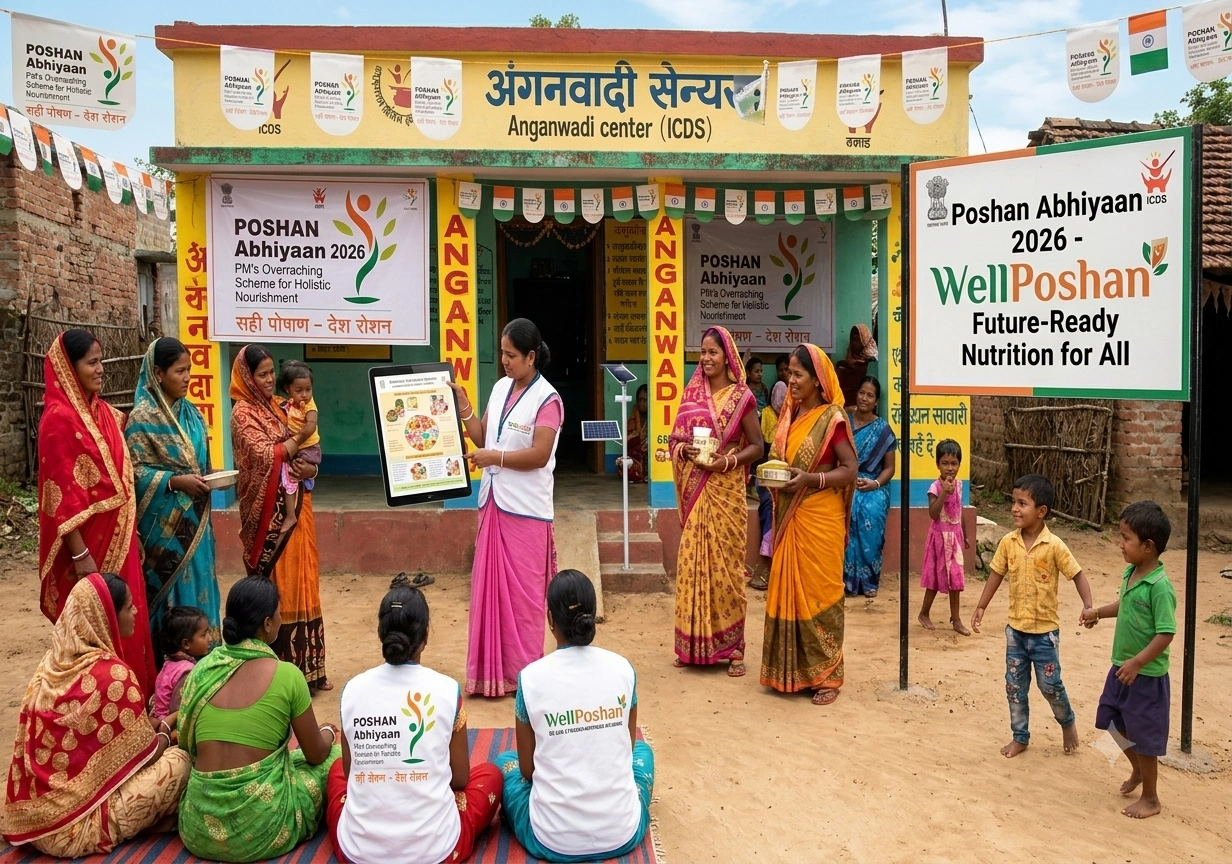
Rashtriya Poshan Maah 2026 — the 9th edition kicked off on 9 September 2026 in Varanasi, themed “Hamari Anganwadi, Hamari Jimmedari” (“Our Anganwadi, Our Responsibility”), with a focus on dietary diversity, protein-rich foods, and community ownership of local Anganwadi Centres.
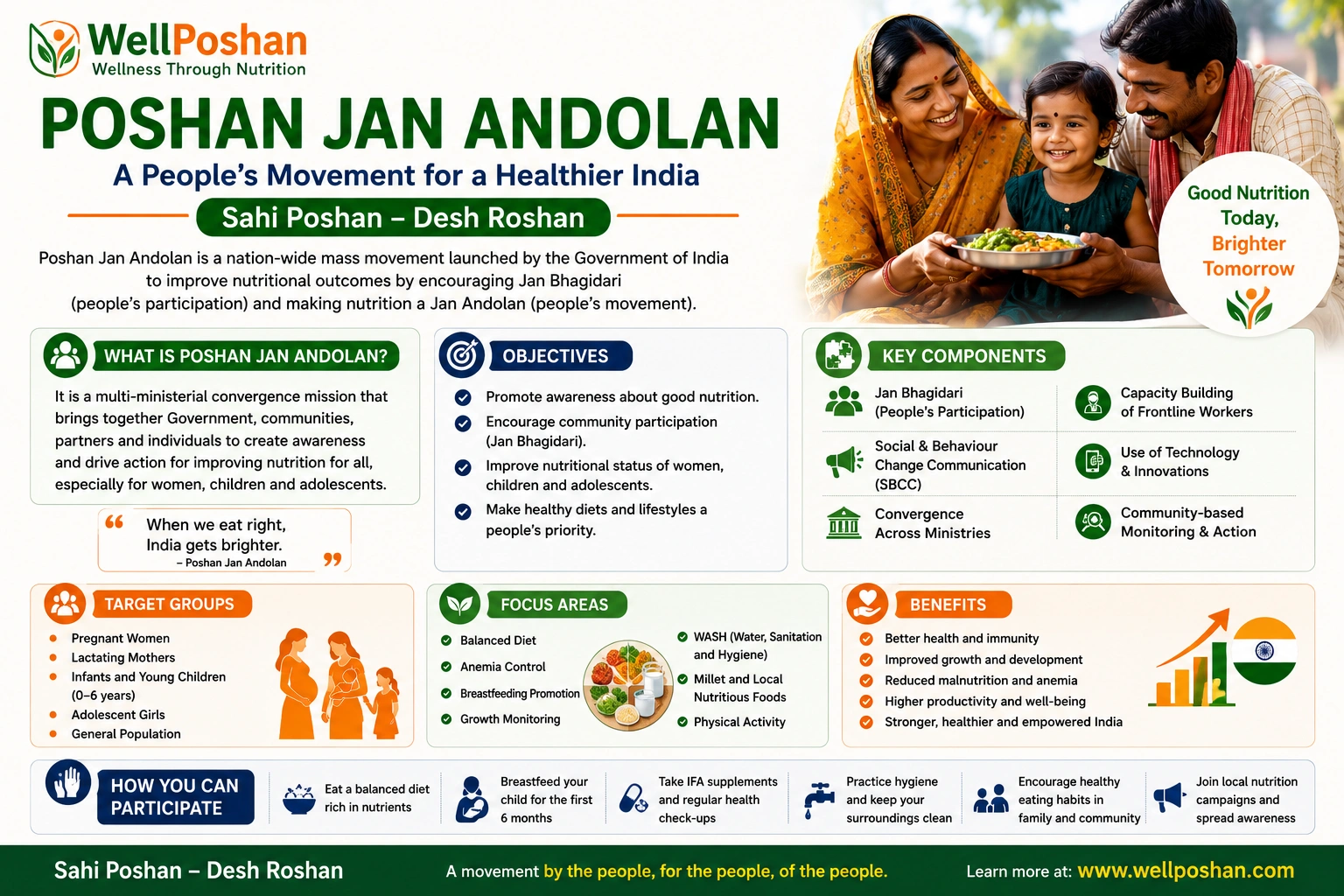
Both campaigns are what make Poshan Abhiyaan feel less like a government file and more like a Jan Andolan — a people’s movement, since so much of the actual work happens through community volunteers, not just officials.
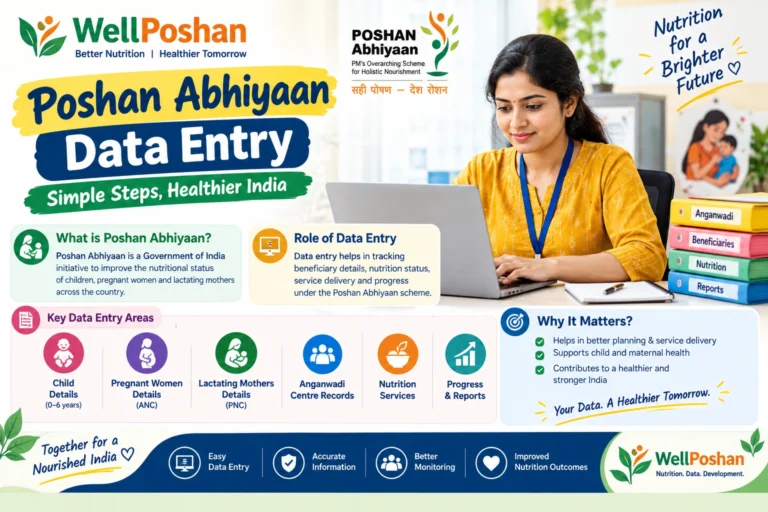
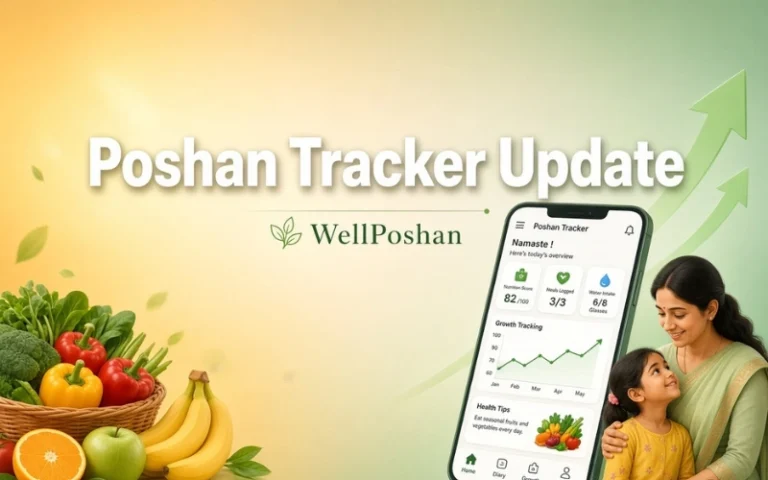
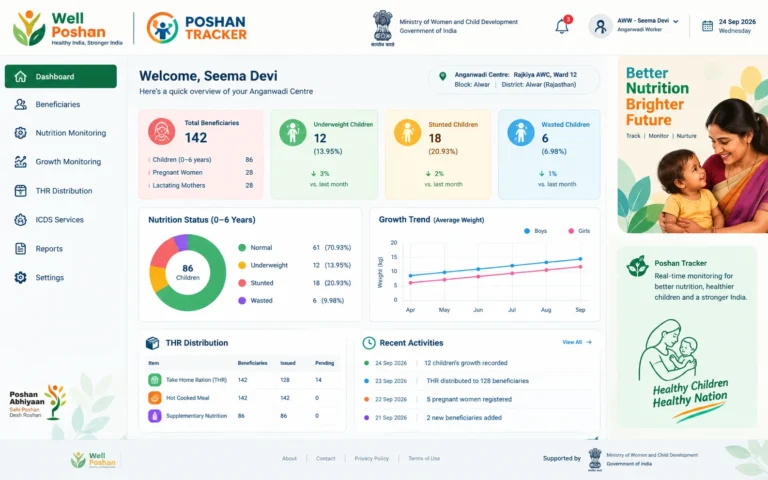
Poshan Tracker and Data Entry: How the Numbers Get Collected
This is the part most people search for, so let’s break it down simply.
Before 2021, an Anganwadi Worker had to maintain 11 separate paper registers — meals served, weights recorded, supplements handed out, all written by hand. Poshan Tracker digitised that entire process.
How Poshan Abhiyaan 2026 data entry works, step by step:
- The Anganwadi Worker logs into the Poshan Tracker app (available in 12 Indian languages) using her registered mobile number.
- She marks the centre as open/closed and records daily child attendance.
- She logs services delivered — hot cooked meals, take-home rations, growth measurements (height/weight), and health checkups.
- Data entry for daily tracking is mandatory — if it isn’t uploaded, the centre can be flagged as non-operational in the system.
- No internet in the village? The app has an offline mode, storing entries locally for up to 3 days until connectivity returns.
- Supervisors and district officials then see all of this on a live dashboard — no more waiting for a monthly paper summary.
As of May 2026, this system was tracking growth data for over 6.3 crore children aged 0–5, roughly 94% of all registered child beneficiaries.
Poshan Abhiyaan vs Poshan 2.0 vs ICDS: What’s the Difference?
People mix these up constantly, so here’s a side-by-side:
| Feature | POSHAN Abhiyaan (2018) | Mission Poshan 2.0 (2021–present) | ICDS |
|---|---|---|---|
| What it is | The original national nutrition mission | The current umbrella scheme that absorbed POSHAN Abhiyaan | The older scheme (since 1975) delivering Anganwadi services |
| Core focus | Convergence + real-time monitoring | Strategic shift toward “care, health, immunity” | Health, nutrition, and pre-school education delivery |
| Tech backbone | — | Poshan Tracker | Feeds data into Poshan Tracker |
| Status today | Merged into Poshan 2.0 | Active, current framework | Still the delivery arm on the ground |
The Numbers So Far: What’s Actually Changing?
- Poshan Pakhwada 2025 alone saw over 6.97 crore sensitisation activities run across states, in partnership with multiple ministries.
- As of May 2026, over 5.5 crore beneficiaries received supplementary nutrition for at least 15 days a month, and 5.17 crore for at least 21 days.
- Anganwadi Centres have grown to nearly 14 lakh nationwide.
These numbers suggest real reach — but reach isn’t the same as outcome. Independent nutrition surveys (like NFHS) are the ones that ultimately tell us whether stunting and wasting rates are actually falling; Poshan Tracker mainly tells us how well services are being delivered.
Challenges That Still Remain
- Data quality vs. data quantity — a centre marked “compliant” on paper doesn’t always mean a child’s nutrition status genuinely improved.
- Last-mile connectivity — patchy internet in remote areas still makes daily digital entry harder than it sounds.
- Behaviour change is slow — awareness campaigns can shift habits like breastfeeding practices, but old habits around food and hygiene take years, not months, to shift.
Quick Glossary
| AWC | Anganwadi Centre, the local hub delivering nutrition and early-childhood services. |
| AWW | Anganwadi Worker, the frontline staff member running an AWC. |
| SNP | Supplementary Nutrition Programme (extra food/rations for beneficiaries). |
| THR | Take-Home Ration. |
| HCM | Hot Cooked Meals served at the centre. |
| IYCF | Infant and Young Child Feeding practices. |
FAQs on Poshan Abhiyaan 2026
1. What does “POSHAN” actually stand for?
It stands for “Prime Minister’s Overarching Scheme for Holistic Nourishment” — the government’s flagship nutrition mission launched in March 2018.
2. Who is eligible for benefits under Poshan Abhiyaan 2026?
Children aged 0–6, pregnant women, lactating mothers, and (in select areas) adolescent girls, all registered through their local Anganwadi Centre.
3. What’s the difference between Poshan Abhiyaan and Mission Poshan 2.0?
Poshan Abhiyaan was the original 2018 mission. In 2021 it was merged into the broader Mission Poshan 2.0, which now serves as the umbrella framework.
4. What is Poshan Tracker, and is data entry mandatory?
It’s the government’s digital platform for recording Anganwadi service delivery. Daily tracking (attendance, meals, growth data) is mandatory for Anganwadi Workers, with an offline mode for areas with poor connectivity.
5. When does Poshan Pakhwada 2026 happen, and what’s the theme?
It ran from 9–23 April 2026, focused on “Maximising Brain Development in the First Six Years of Life.”
6. How can a beneficiary check their Anganwadi Centre’s records?
Beneficiaries whose mobile number is registered with their Anganwadi Centre can log into the Poshan Tracker beneficiary portal using OTP verification, without needing a separate app or password.
Next Questions to Explore
- How does Poshan Abhiyaan compare to nutrition programmes in other countries?
- What do the latest NFHS survey numbers say about stunting trends in India?
- How does Poshan 2.0 fund and train Anganwadi Workers?
Conclusion
Poshan Abhiyaan 2026 isn’t a single handout scheme — it’s India’s attempt to fight malnutrition with three tools at once: community mobilisation (Poshan Pakhwada and Poshan Maah), on-the-ground service delivery (Anganwadi Centres), and real-time digital accountability (Poshan Tracker). The reach is genuinely large — tens of millions of beneficiaries and close to 14 lakh centres — but the real test isn’t how much data gets entered; it’s whether stunting, wasting, and anaemia numbers keep falling in the years ahead.
Thank you For Reading!
Also Read –