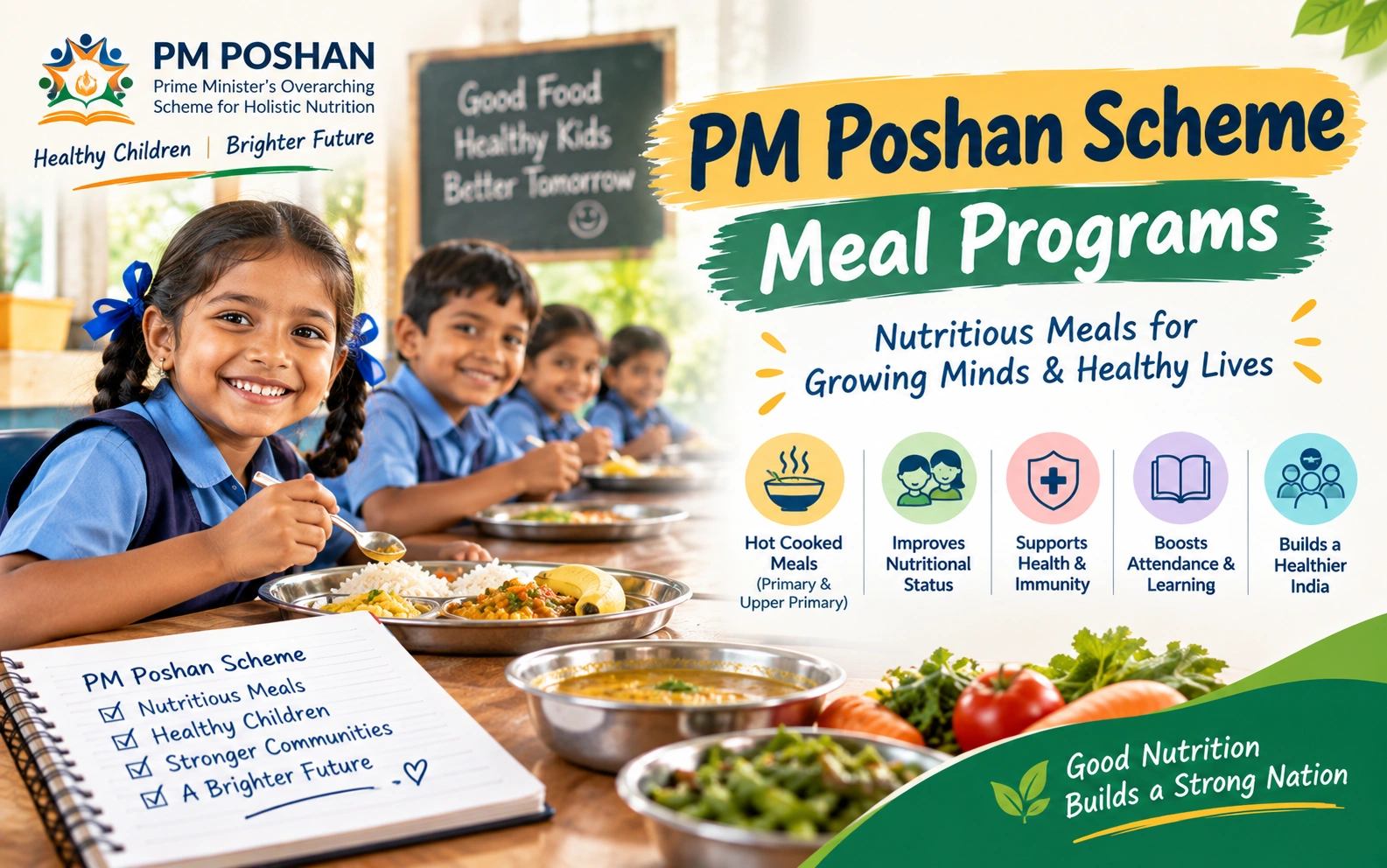
PM Poshan Scheme Meal Programs: Complete 2026 Guide
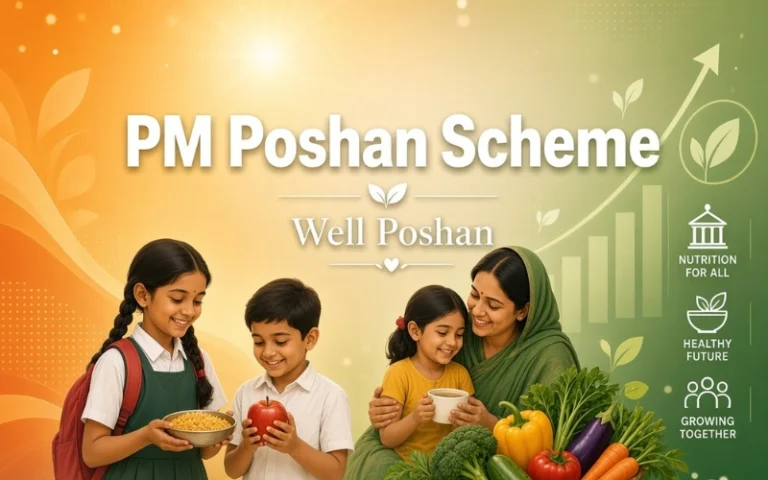
Every school day, tens of millions of children in India line up for a hot, cooked meal under the PM Poshan Scheme meal programs — the government’s largest school feeding effort. But “one hot meal a day” hides a surprisingly detailed system underneath: fixed calorie and protein norms, a cost-sharing formula between the Centre and states, thousands of kitchens run in completely different ways from state to state, and rules covering everything from cooking gas to who gets paid to stir the pot.
This guide breaks down exactly how PM Poshan Scheme meal programs work in 2026 — what’s in the meal, who pays for it, how states run it differently, and what’s happening with the scheme right now.
TL;DR — PM Poshan Scheme Meal Programs at a Glance
- What it is: A free, hot cooked mid-day meal for children in Classes I–VIII (and Balvatika/pre-primary in several states) in government and government-aided schools.
- Nutrition norms: 450 calories and 12g protein for primary students; 700 calories and 20g protein for upper primary students.
- Scale: Around 11.8 crore children across roughly 11.2 lakh schools nationwide.
- Funding: Centre-state cost sharing, usually 60:40 (90:10 for Northeastern, Himalayan states and Jammu & Kashmir; 100% Centre for Union Territories without a legislature).
- Delivery varies by state: Centralised kitchens (Tamil Nadu), women’s self-help groups (Odisha), rotating mother-cooks (Rajasthan), and school-level cooking with state-funded top-ups (West Bengal).
- 2026 status: The scheme’s 2021–26 term was temporarily extended to September 30, 2026, or until the 16th Finance Commission cycle (2026–27 to 2030–31) is formally approved — whichever comes first.
What Are PM Poshan Scheme Meal Programs?
PM Poshan — short for Pradhan Mantri Poshan Shakti Nirman — is the Centrally Sponsored Scheme that replaced the older Mid-Day Meal Scheme in September 2021. The “meal programs” side of PM Poshan Scheme Meal Programs refers specifically to the operational machinery that gets a cooked meal onto a child’s plate every school day: nutrition norms, ingredient quantities, cooking budgets, kitchen infrastructure, and the people who actually cook and serve the food.
The scheme’s roots go back to a school lunch programme in Madras in 1925 and Tamil Nadu’s statewide noon-meal scheme decades later. It became a national programme in 1995, was expanded to upper-primary classes after a 2001 Supreme Court order, and was rebranded PM Poshan in 2021 with an added focus on nutrition gardens, community participation and local ingredient sourcing.
What’s the Nutrition Standard for PM Poshan Scheme Meal Programs?
The National Food Security Act, 2013 fixes the nutrition norms by law — states cannot serve less than this, though many add extras like eggs, fruit or milk from their own budgets.
| Stage | Classes | Calories | Protein | Food Grains | Pulses | Vegetables | Oil/Fat |
|---|---|---|---|---|---|---|---|
| Primary | I–V | 450 kcal | 12 g | 100 g | 20 g | 50 g | 5 g |
| Upper Primary | VI–VIII | 700 kcal | 20 g | 150 g | 30 g | 75 g | 7.5 g |
Remember: These are minimums, not menus. The Centre sets the nutritional target; state governments and school-level committees decide the actual dishes — rice or wheat-based, khichdi, sambar-rice, dal-chawal and so on — based on regional food habits and what’s locally available.
Who Pays for PM Poshan Scheme Meal Programs, and How Much?
PM Poshan Scheme Meal Programs run on a fixed set of cost components, each shared between the Centre and states in different ratios.
| Component | Central Norm (base rate) | Cost-Sharing Pattern |
|---|---|---|
| Food grains | Free — 100g/child/day (primary), 150g/child/day (upper primary) | 100% Centre (grain + transport to FCI depot) |
| Cooking cost | ₹4.97/child/day (primary), ₹7.45/child/day (upper primary), base rate from April 2020, revised roughly 7.5% each year | 60:40 Centre:State (90:10 in NE/Himalayan states and J&K) |
| Honorarium to cook-cum-helper | ₹1,000/month for 10 months per cook-cum-helper (minimum norm) | 60:40 Centre:State |
| Transportation assistance | Up to ₹1,500 per metric tonne of food grain | Mostly Centre-borne |
| Management, Monitoring & Evaluation (MME) | 3% of the aggregate cost of the above components | Shared |
In practice, the central cooking-cost figure is a floor, not a ceiling. States regularly top it up from their own budgets — for example, West Bengal raised its cooking cost to ₹10 per child per day and lifted the monthly cook-cum-helper honorarium to ₹3,000 in 2026, well above the central minimum.
Cook-cum-helper engagement norms: One cook-cum-helper for schools with up to 25 students, two for schools with 26–100 students, and one additional helper for every further 100 students.
How Do States Actually Run Their PM Poshan Scheme Meal Programs?
This is where PM Poshan Scheme Meal Programs look nothing alike from one state to the next. The Centre sets the nutrition target and funding formula; states choose the delivery model.
| State | Meal Program Delivery Model |
|---|---|
| Tamil Nadu | Over 400 centralised kitchens (many run with Akshaya Patra); eggs served five days a week |
| Odisha | More than 6,500 women’s self-help groups under Mission Shakti cook and manage meals |
| Rajasthan | “Annapurna Mata” model — a rotating roster of mothers cook and monitor meals at the school level |
| West Bengal | Meals cooked at the school level; eggs or chicken added twice a week using state funds; an active 2026 drive is converting firewood-based kitchens to LPG |
Because implementation is state-led, two schools just across a state border can serve very different meals, cooked by very different people, even though both follow the same central calorie and protein norms.
What Extra Features Are Part of PM Poshan Scheme Meal Programs?
Fortified food grains: Food grains distributed through the Food Corporation of India are increasingly fortified to help address micronutrient gaps.
Do All Schools Serve Eggs Under PM Poshan Scheme Meal Programs?
No — this is one of the most commonly searched questions about PM Poshan Scheme Meal Programs, and the answer is state-specific. The central government sets calorie and protein targets but does not mandate any single food item, including eggs. States decide the actual menu:
- Tamil Nadu and West Bengal serve eggs (or a chicken alternative) multiple days a week, funded from state budgets.
- Other states substitute vegetarian protein sources such as pulses, soya or groundnut-based items to meet the same protein target without eggs.
- The choice is usually tied to local dietary preference and state policy, not a national rule.
How Many Children and Schools Does the PM Poshan Scheme Meal Programs Cover?
- Beneficiaries: Roughly 11.8 crore children.
- Schools covered: Around 11.2 lakh government and government-aided schools.
- Classes covered: I–VIII, with Balvatika/pre-primary included in a growing number of states.
- Who’s excluded: Children in private, unaided schools are not covered by PM Poshan meal programs, since the scheme applies only to government and government-aided institutions.
What’s the Current Status of PM Poshan Scheme Meal Programs in 2026?
The PM Poshan Scheme Meal Programs’s approved term ran from 2021–22 to 2025–26. As that period ended on March 31, 2026, the Union Government issued a temporary extension — continuing the scheme with the same scope, structure, coverage and cost norms as the 2021–26 cycle — up to September 30, 2026, or the date the scheme is formally approved for the 16th Finance Commission cycle (2026–27 to 2030–31), whichever is earlier.
State-level budget approvals for FY 2026–27 (such as Haryana’s ₹747 crore sanction) have continued in parallel under this extension. As of this writing, formal approval for the next five-year cycle is still pending, so it’s worth checking the official PM Poshan portal for the latest update on the 2026–27 onward scheme structure.
Glossary of PM Poshan Meal Program Terms
| PM Poshan (PM-POSHAN) | Pradhan Mantri Poshan Shakti Nirman — the current name of the national school meal scheme, formerly the Mid-Day Meal Scheme. |
| NFSA | National Food Security Act, 2013 — the law that legally fixes the scheme’s calorie and protein norms. |
| Centrally Sponsored Scheme (CSS) | A scheme jointly funded by the Centre and states in a fixed ratio. |
| FCI | Food Corporation of India — supplies the free food grains used in meals. |
| MME | Management, Monitoring and Evaluation — the administrative cost component of the scheme’s budget. |
| Cook-cum-helper | The person engaged at school level to cook and serve the meal, paid a monthly honorarium. |
| Balvatika | Pre-primary classes attached to primary schools, increasingly brought under meal coverage. |
| Tithi Bhojan | A community-sponsored special meal served on festivals or family occasions. |
| 16th Finance Commission cycle | The upcoming five-year central funding cycle (2026–27 to 2030–31) that will determine the scheme’s next long-term structure. |
FAQs About PM Poshan Scheme Meal Programs
1. What exactly is included in a PM Poshan Scheme Meal Programs?
A hot cooked meal meeting fixed calorie and protein norms — 450 calories/12g protein for primary students and 700 calories/20g protein for upper primary students — made from food grains, pulses, vegetables and oil supplied or funded under the scheme.
2. Who funds PM Poshan Scheme Meal Programs?
Funding is shared between the Centre and states, typically in a 60:40 ratio (90:10 for Northeastern and Himalayan states and Jammu & Kashmir, and 100% Centre for Union Territories without a legislature). The Centre also bears the full cost of food grains and their transport to FCI depots.
3. How much money is spent per child under the meal program?
The central cooking-cost norm is a base rate of roughly ₹4.97/day for primary and ₹7.45/day for upper primary students, revised upward by about 7.5% each year. Many states add their own funds on top — West Bengal, for instance, raised its per-child cooking cost to ₹10/day in 2026.
4. Do all PM Poshan schools serve eggs?
No. The Centre sets nutrition targets, not specific menu items. States like Tamil Nadu and West Bengal include eggs regularly, while others meet the same protein target with vegetarian alternatives.
5. Are private school students covered under PM Poshan meal programs?
No. The scheme covers only government and government-aided schools; children in private, unaided schools are not eligible.
6. What is Tithi Bhojan under the PM Poshan Scheme?
It’s a community-participation feature where families or local groups sponsor a special festive meal for schoolchildren on occasions like birthdays or festivals, supplementing the regular meal at no extra cost to the government.
7. Is the PM Poshan Scheme still active in 2026?
Yes. Its 2021–26 term was temporarily extended to September 30, 2026, or until the scheme is approved for the 16th Finance Commission cycle (2026–27 to 2030–31), whichever comes first, with the same scope and cost norms continuing in the meantime.
8. Who cooks the meals under PM Poshan Scheme Meal Programs?
Cook-cum-helpers engaged at the school level, or, depending on the state’s delivery model, centralised kitchen staff (Tamil Nadu), women’s self-help groups (Odisha), or a rotating roster of mothers (Rajasthan).
Disclaimer
This article is for general informational purposes and is based on publicly available government sources, official scheme guidelines and news reports available at the time of writing (September 2026). Cost norms, honorariums and scheme timelines are revised periodically by the Centre and individual states. For the most current and location-specific details, please refer to the official PM Poshan portal or your state’s School Education Department.