PM Poshan Yojana 2026: Meals, Menu, Budget & Bharti Guide
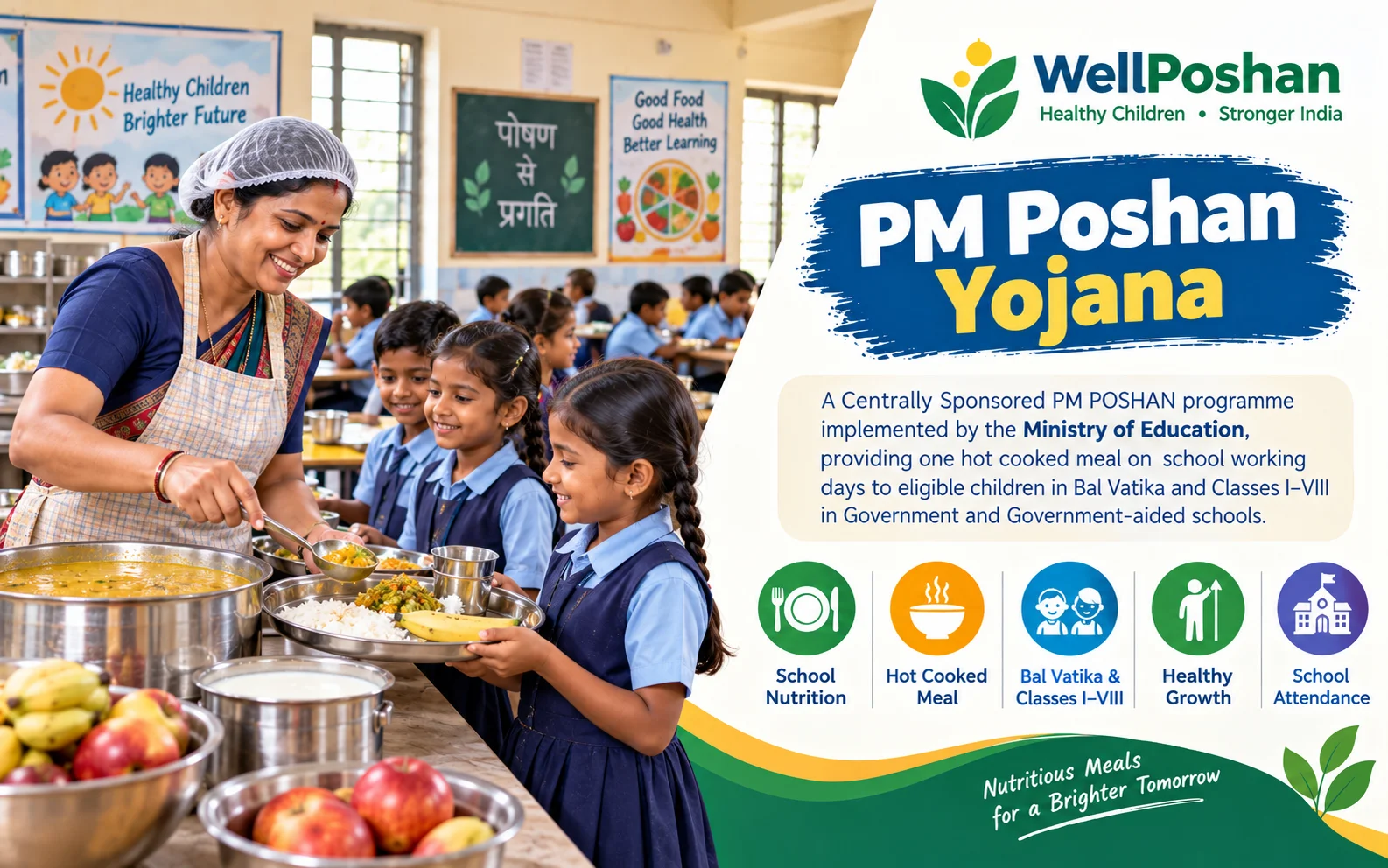
PM Poshan Yojana is India’s free hot-cooked school meal scheme, run by the Ministry of Education, that feeds roughly 11.80 crore children from Balvatika to Class 8 in government and government-aided schools on every school day.
Picture a government school in Bihar at 12:30 p.m. The bell rings, steel plates clang, and a cook-cum-helper ladles out khichdi to a line of hungry kids. It looks simple. It isn’t.
Behind that one plate sits a ₹12,750 crore national machine with menus, rate lists, daily reporting apps, honorarium disputes and a funding clock that ran out on 31 March 2026.
This guide unpacks all of it. What the scheme is, when it started, what children are entitled to, how much each plate costs, how the PM Poshan Yojana app works, and what the PM Poshan Yojana Bharti 2026 noise is really about.
No fluff. Just what you need, whether you’re a parent, a teacher, a cook, or a UPSC aspirant.
PM Poshan Yojana 2026 at a Glance
| Item | Snapshot (updated 3 October 2026) |
|---|---|
| Full name | Pradhan Mantri Poshan Shakti Nirman (PM POSHAN) |
| Earlier name | Mid-Day Meal Scheme (MDM) |
| Ministry | Ministry of Education (Dept. of School Education & Literacy) |
| Type | Centrally Sponsored Scheme, Centre–State funding at 60:40 |
| Coverage | About 11.80 crore children in about 11.20 lakh schools |
| Who gets it | Balvatika and Classes 1–8 in government and aided schools |
| Union Budget 2026-27 (BE) | ₹12,750 crore, up 20% over 2025-26 RE |
| Cooking (material) cost | ₹6.78 primary, ₹10.17 upper primary per child per day (since 1 May 2025) |
| Scheme status | Original term ended 31 March 2026; running on a temporary extension |
PM Poshan Yojana Kya Hai? (What Is It, Really?)
PM Poshan Yojana is the 2021 rebrand of the Mid-Day Meal Scheme. It guarantees one hot-cooked, nutritionally defined meal to every eligible child, free of cost, regardless of gender or social class.
Its job is twofold: fight classroom hunger and pull poor children into school (and keep them there).
You will also see it written as MDM PM Poshan Yojana. Same scheme, old name stuck to the new one, like a school nickname that outlives the uniform.
PM Poshan Yojana in Hindi (हिंदी में सार)
पीएम पोषण योजना क्या है? पीएम पोषण योजना (पहले मध्याह्न भोजन योजना) शिक्षा मंत्रालय की केंद्र प्रायोजित योजना है। इसके तहत सरकारी और सरकारी सहायता प्राप्त स्कूलों में बाल वाटिका से कक्षा 8 तक के बच्चों को हर स्कूल दिवस पर एक पौष्टिक, गरम पका भोजन मुफ्त मिलता है। मकसद दो हैं: बच्चों की भूख मिटाना और स्कूल में उपस्थिति बढ़ाना।
Five Terms You Must Know
PM Poshan Yojana Kab Shuru Hui? Launch Date and Timeline
So if an exam asks PM Poshan Yojana started in which year, the safest answer is 2021 (as PM POSHAN), with a note that the programme itself dates to 1995. The same logic answers PM Poshan Yojana Kab Start Hui, PM Poshan Yojana Launch Date and PM Poshan Shakti Yojana Kab Shuru Hui.
| Year | Milestone |
|---|---|
| 1925 | A mid-day meal programme for disadvantaged children starts in Madras Municipal Corporation |
| 1984 | Gujarat begins its state mid-day meal scheme |
| 15 Aug 1995 | National Programme of Nutritional Support to Primary Education launched |
| 2013 | National Food Security Act (Section 5) makes the meal a legal entitlement up to Class 8 |
| 29 Sep 2021 | Cabinet approves PM POSHAN for 2021-22 to 2025-26; Balvatika added |
| 1 May 2025 | Material cost raised by 9.5% |
| 31 Mar 2026 | Original scheme period ends |
| Apr–May 2026 | Centre grants temporary extension to 30 Sep 2026 (or until the next five-year approval, whichever is earlier) |
PM Poshan Yojana Under Which Ministry? Who Are the Beneficiaries?
PM Poshan Yojana comes under the Ministry of Education, specifically the Department of School Education & Literacy. That is the answer to PM Poshan Yojana Kis Mantralaya Mein Hai and PM Poshan Yojana Under Which Ministry.
Here’s a common trap. Anganwadi-focused programmes like Poshan Abhiyaan and Saksham Anganwadi & Poshan 2.0 sit with the Ministry of Women and Child Development. Different “Poshan”, different ministry.
PM Poshan Yojana Ke Mukhya Labharthi Kaun Hai?
- Children in Balvatika (pre-primary) in government and aided primary schools
- Students of Classes 1 to 8 in government and government-aided schools
- Children in Special Training Centres, madrasas and maqtabs supported under Samagra Shiksha
PM Poshan Yojana UPSC: The Exam Angle
Aspirants should lock these in:
- Centrally Sponsored Scheme, 60:40 sharing (90:10 for special-category states like J&K)
- Legal backing under NFSA 2013
- Nutrition norms: 450 kcal / 12 g protein (primary), 700 kcal / 20 g (upper primary)
- Features: Balvatika inclusion, Tithi Bhojan, school nutrition gardens (in more than 3 lakh schools), mandatory social audit
- Mains debates: eggs in menus, stagnant cook honorarium, leakage, extension to breakfast and Class 10
What’s on the Plate: Norms, Rates and a Cost Formula
Here’s what the Centre fixes, per child, per school day. States choose the actual dishes.
| Component | Primary (Balvatika, I–V) | Upper Primary (VI–VIII) |
|---|---|---|
| Calories | 450 kcal | 700 kcal |
| Protein | 12 g | 20 g |
| Food grain (rice/wheat) | 100 g | 150 g |
| Pulses | 20 g | 30 g |
| Vegetables | 50 g | 75 g |
| Oil | 5 g | 7.5 g |
| Material cost (from 1 May 2025) | ₹6.78 | ₹10.17 |
The PM Poshan Yojana Bihar Rate List (and Everyone Else’s)
When people search for the PM Poshan Yojana Bihar Rate List, they want the per-child cooking rate. The national material cost above applies across states and UTs. Some states add their own top-up. West Bengal, for example, announced a state-funded rise to ₹10 for primary from 1 August 2026.
Why does the rate matter? Because it is the pressure valve of the whole scheme. When prices rise faster than the rate, schools quietly trim eggs, dal and vegetables. The Accountability Initiative (CPR) calculated that food inflation rose 23.7% between April 2020 and October 2022, while the cooking cost rose only 9.6%.
Copy-Paste Daily Calculator (Formula + Example)
Worked example: 80 primary and 40 upper-primary children present today.
| Item | Calculation | Result |
|---|---|---|
| Rice | 8 kg + 6 kg | 14 kg |
| Pulses | 1.6 kg + 1.2 kg | 2.8 kg |
| Vegetables | 4 kg + 3 kg | 7 kg |
| Oil | 0.4 kg + 0.3 kg | 0.7 kg |
| Cooking cost | ₹542.40 + ₹406.80 | ₹949.20 |
PM Poshan Yojana Bihar: Menu, List and Report
Bihar is where many searches originate, so let’s be specific.
PM Poshan Yojana Bihar Menu
The latest weekly menu I could verify on Bihar’s MDM portal took effect on 15 February 2025:
| Day | Menu |
|---|---|
| Monday | Rice, mixed dal with green vegetables |
| Tuesday | Rice, aloo-soyabean sabji |
| Wednesday | Rice, red chana chhola |
| Thursday | Rice, mixed dal with green vegetables |
| Friday | Rice, red chana chhola, one boiled egg (or seasonal fruit for non-egg eaters) |
| Saturday | Khichdi with green vegetables and chokha |
Bihar also serves fortified rice, a micronutrient-boosted rice meant to tackle anaemia. Schools are expected to write the menu on the school wall, which brings us to the cheapest accountability tool in India: a painted wall that parents can read.
PM Poshan Yojana Bihar List and Report
List: There is no “beneficiary list” to get your name on. Every enrolled child is covered. The lists you’ll find online are school-wise lists, cook-cum-helper lists and district reports on the state MDM portal.
Report: The PM Poshan Yojana Bihar Report is the daily and monthly meals-served data that schools file through Bihar’s online MIS. It drives rice allotment and fund release.
State Snapshots: Gujarat, Jharkhand and the Egg Divide
PM Poshan Yojana sets nutrition targets, not specific foods. States decide the menu. That’s why a child in Chennai and a child in Ahmedabad eat very different lunches under the same scheme.
| State | What stands out |
|---|---|
| PM Poshan Yojana Gujarat | No eggs, but a daily breakfast added on top of the mid-day meal |
| PM Poshan Yojana Jharkhand | Egg or seasonal fruit on 2 days a week |
| Bihar | Egg or fruit on 1 day a week |
| Tamil Nadu | Egg or banana on every school day |
(Source: Outlook India’s June 2026 data analysis and Ministry of Education replies.)
Mini Case Study: Gujarat’s Breakfast Add-On
In December 2024, Gujarat launched the Mukhyamantri Paushtik Alpahar Yojana. Chana chaat, mixed beans and sukhdi are served at prayer time for about 41 lakh students across 32,277 government and grant-in-aid primary schools, with roughly ₹617 crore a year earmarked.
Why it works: the base meal already hits the Centre’s minimum norms, so the extra breakfast targets the hungry-morning gap rather than replacing anything. The lesson for other states: when you can’t change the menu politically (eggs, say), you can still add a second meal.
PM Poshan Yojana App and Login: Where the Data Goes
Every plate served becomes a data point. Here’s how that works.
PM POSHAN (ARMS) app and web portal: schools report daily meals served via the web interface or SMS. The mobile app can send figures by SMS, so it works even without internet.
State apps: Odisha, Gujarat, Himachal Pradesh and others run their own PM Poshan Yojana app versions.
Mp PM Poshan Yojana Login: Madhya Pradesh runs a state PM Poshan Shakti Nirman portal built by NIC with Aadhaar-enabled authentication for collecting food grains. Logins are issued by the department to schools, cooking agencies and officials, not to the public.
The honest benchmark: according to IBEF, as of 30 April 2026 daily reporting covered 143,324 of 211,366 schools in reporting states and UTs. That is about 68%. Roughly one in three schools was not yet in the daily data loop.
PM Poshan Yojana Bharti 2026: Cooks, Helpers and a Reality Check
Every year, websites scream “PM Poshan Yojana Bharti 2026, apply online!” with promised salaries of ₹5,000 to ₹8,000. Let’s slow down.
There is no single national recruitment. Cook-cum-helpers are engaged locally, usually by School Management Committees, with preference to local women and self-help groups. The Centre fixes the norms, and states do the hiring.
How Many Cooks Per School?
| Enrolment | Cook-cum-helpers allowed |
|---|---|
| Up to 25 students | 1 |
| 26 to 100 students | 2 |
| Each additional 100 students | +1 |
So a school with 130 children can have 3.
What Do They Actually Earn?
| Level | Honorarium |
|---|---|
| Central share | ₹1,000 per month for 10 months, unchanged since 2009 |
| West Bengal (state portal, from Aug 2026) | ₹3,000 total |
| Delhi (cited by a cook union) | ₹8,000 |
| Kerala (cited by a cook union) | ₹12,000 |
Twenty-two states and UTs have petitioned the Ministry of Education for a higher central share. Bihar, Uttar Pradesh and Jharkhand suggested ₹2,500 to ₹5,000 per month.
Copyable Workflow: Applying Safely
- Ask your Block Education Office or school’s SMC about vacancies.
- Look for a written notice from the school, block or district MDM office.
- Prepare Aadhaar, bank passbook, residence proof and any local-resident certificate.
- Never pay a fee. Genuine engagement through the SMC doesn’t charge applicants.
- Get the appointment or engagement order in writing, with honorarium and months stated.
Author’s POV: What the Numbers Don’t Tell You
After going through the central norms, state circulars and 2026 data, here’s my read.
- The honorarium is the weakest link. A scheme can set perfect calorie norms, but the person who makes them real earns ₹1,000 centrally. When 22 states ask for a hike, it’s not politics. It’s a staffing problem waiting to become a quality problem.
- The material cost always lags. The 2025 hike of 9.5% was based on rural labourer inflation data and cost the Centre about ₹954 crore extra in 2025-26. Good, but indexation by definition looks backward. Schools feel prices in real time.
- Paperwork is where meals quietly fail. Daily figures drive rice drawn and money released. A school that counts enrolled children instead of present children bleeds accuracy every day.
- The egg debate is a distraction from the real question. The scheme mandates nutrition targets, not eggs. Gujarat meets the norms without eggs by adding breakfast. The better question: is each child getting the protein the norm promises?
The 5P Plate Audit: A Framework Anyone Can Use
Parents, teachers, SMC members and aspirants can use this checklist to judge any school’s PM Poshan Yojana delivery in ten minutes.
| P | Check | Pass looks like |
|---|---|---|
| Plate | Is today’s meal the menu on the wall? | Menu matches, portions look right, egg/fruit on its day |
| Paper | Are daily figures filed on time? | Present-children count matches the attendance register |
| People | Are enough cooks engaged and paid? | Cook count fits the enrolment table, honorarium paid |
| Purse | Is spending in line with ₹6.78 / ₹10.17 (or the state rate)? | Daily cost matches present children × rate |
| Proof | Is there a tasting register and a visible social audit? | Teacher tastes before serving; records are open to parents |
Before and After: A Transformation Example
This is an illustrative composite, not a single named school.
Before: A 130-child upper-primary school has no wall menu. Attendance is guessed from memory, the cook is unsure of quantities, and monthly reports don’t match stock.
After applying the 5P audit and the daily calculator:
- The menu is painted on the wall, with egg/fruit marked on Friday.
- The teacher records present children by 11 a.m. and uses the formula for quantities.
- The SMS or app report goes out the same day.
- A parent rota tastes the meal once a week.
Result: stock and consumption reconcile, wastage drops, and the cook knows exactly what to prepare. Nothing about the budget changed. Only the discipline did.
Common Mistakes to Avoid
- Hunting for an application form. Enrolled children are covered automatically.
- Trusting inflated “Bharti” salaries. The central honorarium share is ₹1,000.
- Mixing up Poshan schemes. PM Poshan Yojana (Education) is not Poshan Abhiyaan (Women & Child Development).
- Quoting outdated rates. ₹5.45 / ₹8.17 and ₹4.97 / ₹7.45 are old. Current central rates are ₹6.78 / ₹10.17.
- Assuming one national menu. States decide dishes, so always check yours.
- Counting enrolled instead of present children. It breaks your stock and cost math.
- Treating the extension as the final word. Check the official portal for the next five-year approval.
Conclusion: Why PM Poshan Yojana Still Matters in 2026
PM Poshan Yojana is part school lunch, part attendance policy, part public health programme, and part women’s employment scheme. It reaches more children daily than almost any other government programme.
It also faces real tests in 2026: a pending next-cycle approval, a cook honorarium frozen since 2009, and prices that outrun the rate. The meal itself, though, is the promise the state makes to a child. Keeping it hot, on time and on the menu is everyone’s job.
Key Takeaways
- PM Poshan Yojana is run by the Ministry of Education and covers about 11.80 crore children in Balvatika to Class 8.
- It started nationally in 1995 and became PM POSHAN in 2021.
- Central material cost: ₹6.78 (primary) and ₹10.17 (upper primary) per child per day.
- Budget 2026-27 is ₹12,750 crore, up 20%.
- Menus are state-decided: Bihar gives egg/fruit once a week, Jharkhand twice, Gujarat adds breakfast.
- Cook-cum-helper honorarium (central share) is ₹1,000 per month. There is no single national “Bharti.”
- The original term ended 31 March 2026. Verify the next-cycle approval on the official portal.
Short Summary
Frequently Asked Questions (FAQs)
1. What is PM Poshan Yojana and who runs it?
PM Poshan Yojana is a centrally sponsored scheme that gives one free hot-cooked meal to children in Balvatika and Classes 1 to 8 in government and government-aided schools. It is implemented by the Ministry of Education, with states handling day-to-day delivery.
2. When was PM Poshan Yojana launched?
The national mid-day meal programme began on 15 August 1995. It was renamed and restructured as PM Poshan Yojana after Cabinet approval on 29 September 2021, effective 2021-22.
3. Is PM Poshan Yojana still running in 2026?
Yes, meals continue. The original term ended on 31 March 2026, and the Centre granted a temporary extension to 30 September 2026 or until approval of the next cycle. I couldn’t find a published final approval as of 3 October 2026, so check the official portal for updates.
4. Can I apply for PM Poshan Yojana Bharti 2026 online?
There is no single national online recruitment. Cook-cum-helpers are engaged locally by School Management Committees under state rules. The central honorarium share is ₹1,000 per month, so be wary of sites promising ₹5,000 to ₹8,000 for a fee.
5. What is the PM Poshan Yojana Bihar menu in 2026?
The latest weekly menu verified on Bihar’s MDM portal (effective 15 February 2025) runs from mixed dal and aloo-soyabean to red chana chhola, with a boiled egg or seasonal fruit on Friday and khichdi with chokha on Saturday. Check your district office for any newer notification.