Rashtriya Poshan Maah 2026: Theme, Dates, Activities and a Practical Playbook
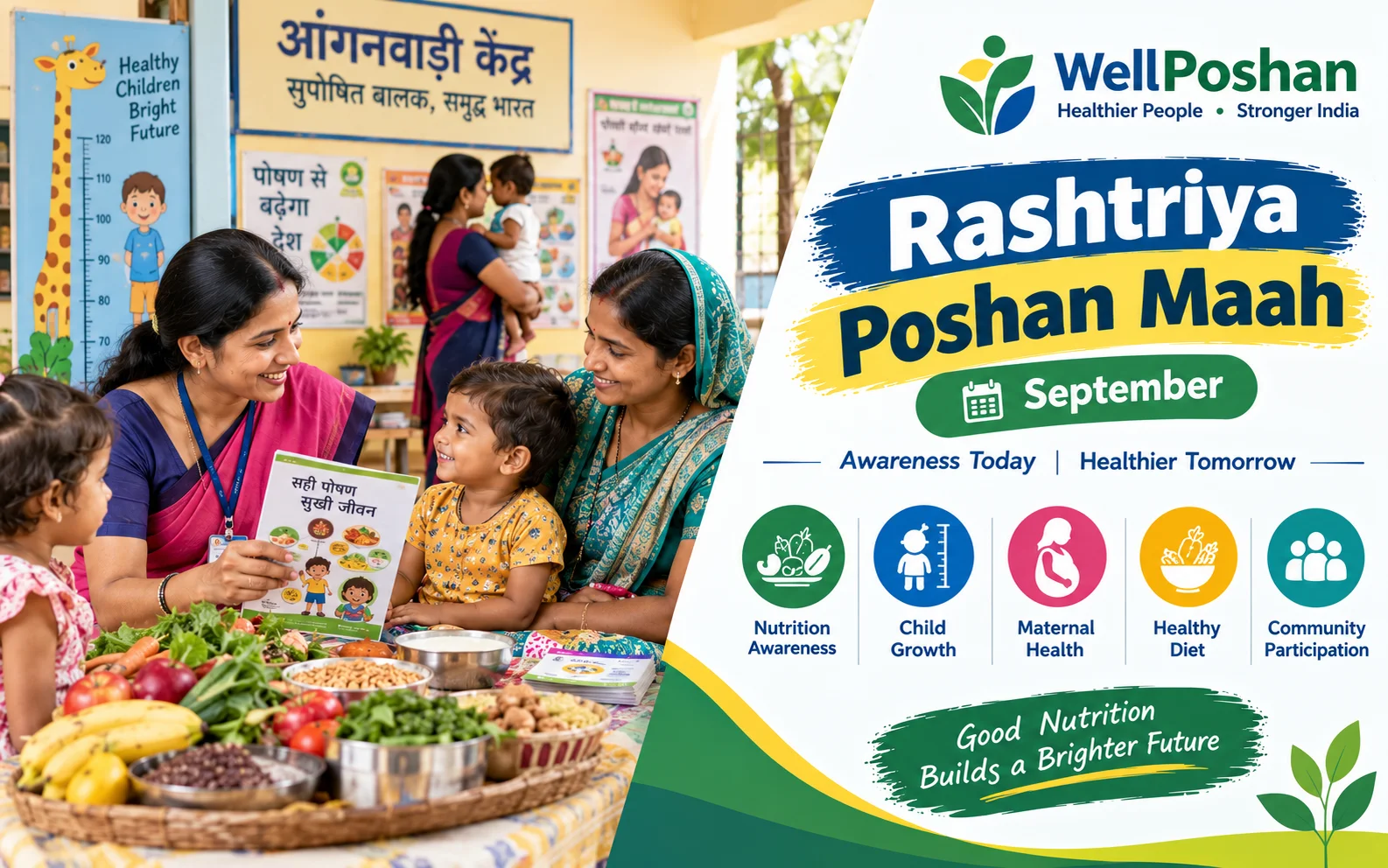
Rashtriya Poshan Maah 2026 is India’s month-long National Nutrition Month, run every September under POSHAN Abhiyaan. The 2026 edition is the 9th, and its theme is “Hamari Anganwadi, Hamari Jimmedari.”
If you’ve been wondering what Rashtriya Poshan Maah 2026 expects from you, the answer is simple. This year the government is asking you, not just the Anganwadi worker, to show up. The central theme calls on every citizen to take shared ownership of Anganwadi centres.
The campaign ends on 8 October, so there’s still time to act. Here is what it is, what changed this year, and how to use the last week well.
What Is Rashtriya Poshan Maah?
Rashtriya Poshan Maah (Rashtriya Poshan Maah in English: National Nutrition Month) is a nationwide awareness-and-action campaign. It mobilises communities and reinforces nutrition, health and caregiving behaviours among pregnant women, lactating mothers, children, adolescents and their families.
Which ministry launched Rashtriya Poshan Maah? The Ministry of Women and Child Development (MWCD). It leads the campaign each year. Health, Education, Rural Development, AYUSH and Panchayati Raj contribute activities through convergence.
When did it start? The campaign has been celebrated every September since 2018. It began alongside POSHAN Abhiyaan, which the Government launched on 8 March 2018.
Rashtriya Poshan Maah 2026 at a Glance
Why “Jimmedari” Is the Smartest Word in the Theme
My read: earlier themes told people what to do (eat iron-rich food, measure growth). This one tells them who is responsible. That matters because nutrition programmes rarely fail on paper. They fail at the last mile, where nobody outside the centre is watching.
When parents, panchayat members and neighbours treat the centre as theirs, quality rises. Menus get followed, growth charts get filled, and the centre opens on time.
The Five Focus Areas of Rashtriya Poshan Maah 2026
The 2026 campaign focuses on five areas: dietary diversity with adequate protein, fresh hot cooked meals, community ownership and accountability, nutrition with early childhood development, and 10 years of PMMVY.
1. Dietary Diversity & Protein
Expect healthy-recipe demonstrations using affordable local ingredients, plus Poshan Melas. The emphasis covers millets, pulses, seeds, milk and animal-source foods.
2. Hot Cooked Meals
The focus is on quality and acceptability through weekly menu rotation, community participation and quality assurance. Anganwadis must also display SNP menu boards listing daily meal entitlements.
3. Community Ownership
At least one committee meeting during the month, plus referrals to health facilities and Rashtriya Bal Swasthya Karyakram teams.
4. Nutrition + Early Learning
For ages 3–6, Anganwadis promote Aadharshila and play-based activities, along with ECCE Day.
5. PMMVY Milestone
A decade of the Pradhan Mantri Matru Vandana Yojana gets a dedicated spotlight during the campaign.
Rashtriya Poshan Maah Edition Timeline: 2018 to 2026
“Which edition of Rashtriya Poshan Maah is it?” is one of the most-asked questions, so here’s the quick map.
What was the Rashtriya Poshan Maah 2024 theme? It had no single slogan. It ran on thematic pillars: anaemia, growth monitoring, complementary feeding, Poshan Bhi Padhai Bhi, technology for better governance, and the “Ek Ped Maa Ke Naam” tree-planting drive.
What was the Rashtriya Poshan Maah 2025 theme? The 8th edition ran under “Swasth Nari, Sashakt Parivar.” It had six pillars: childhood obesity, ECCE, infant and young child feeding, engaging men in nutrition (“Men-streaming”), Vocal for Local, and convergence and digitisation.
2025 vs 2026: What Actually Changed?
2025
2025 was topic-heavy. It covered obesity, men’s role and local foods.
2026
2026 is accountability-heavy. It asks who owns the Anganwadi in your village or ward.
The Numbers Behind Rashtriya Poshan Maah
Good campaigns need good data. Here’s what the evidence says.
- Stunting is falling. NFHS-6 shows under-5 stunting dropping from 35.5% to 29.3%, and severe wasting from 7.7% to 5.2%.
- Wasting is stubborn. About 19% of under-fives are still wasted, per NFHS-6.
- Early diets are the weak link. Only about 15% of breastfed children aged 6–23 months receive an adequate diet.
- Scale of mobilisation: Poshan Maah 2025 logged about 14.33 crore activities across more than 20 ministries. Over 150 crore Jan Andolan activities have been conducted through Poshan Maah, Poshan Pakhwada and related efforts.
Technical Terms, Simply Explained
The ANGAN Audit: A 5-Minute Framework for Any Citizen
Here’s a simple checklist I’d hand any parent or volunteer visiting a centre this month. It turns “responsibility” into something you can actually do.
Why it works: vague concern doesn’t get a response, but a specific observation (“the menu board says eggs, but none were served”) does.
A Copyable Workflow for Poshan Maah Activities
Whether you’re a teacher, an Anganwadi worker or an NGO volunteer, use this sequence.
Poster Making, Chart and Banner: Before vs After
Before
A crowded poster with a generic “Eat Healthy” headline, ten fonts and no action.
After
One message, “Add one protein to every plate.” It has three local foods (dal, eggs, groundnuts), the official logo and one clear call to action.
A 60-Second Speech Template
A Simple PPT Outline
For a PPT on Rashtriya Poshan Maah, five slides are enough:
Mini Case Study: How a Menu Board Can Change a Month
Picture a village Anganwadi where parents have always assumed meals are “fine.” During the month, a mothers’ committee does the ANGAN audit and notices that the menu lists pulses and eggs on alternate days, but only khichdi appears.
They don’t complain loudly. They raise it at the committee meeting and ask the worker what supply constraint exists. The fix is a delivery schedule change. Within weeks the plate matches the board.
Common Mistakes to Avoid
- Treating Poshan Maah as a photo-op. Activities without follow-up don’t change nutrition.
- Overloading the message. Five themes in one poster means zero themes remembered.
- Ignoring local foods. Recipe demos with unaffordable ingredients fail the dietary-diversity goal.
- Skipping reporting. Unreported work is invisible to the system.
- Forgetting the committee meeting. It’s the one activity that builds lasting ownership.
- Confusing Pakhwada with Maah. Poshan Pakhwada is the two-week April edition. Its eighth edition ran from 9 to 23 April 2026. Rashtriya Poshan Maah is the September month-long one.
Conclusion: Make Rashtriya Poshan Maah a Habit, Not an Event
Rashtriya Poshan Maah 2026 hands the community a clear job: look after your Anganwadi. Stunting has fallen from 35.5% to 29.3%, but wasting and early-childhood diets show how much local work remains. Pick one focus area, run the ANGAN audit, report your activity and keep going after 8 October.
Key Takeaways
Summary
Rashtriya Poshan Maah is MWCD’s annual National Nutrition Month. The 2026 edition shifts focus from awareness to ownership. This guide covered the theme, the edition timeline from 2018 to 2026, key data, a citizen-friendly audit framework and a practical workflow for posters, speeches and reporting.
FAQs
1. What is Rashtriya Poshan Maah?
Rashtriya Poshan Maah is India’s annual National Nutrition Month, a campaign under POSHAN Abhiyaan that mobilises communities around nutrition for women, children and adolescents.
2. What is the Rashtriya Poshan Maah 2026 theme?
The theme is “Hamari Anganwadi, Hamari Jimmedari,” meaning “Our Anganwadi, Our Responsibility.” It puts community ownership of Anganwadi centres at the centre.
3. Which edition of Rashtriya Poshan Maah is 2026?
It is the 9th edition. The 8th was held in 2025 (launched from Dhar, Madhya Pradesh), and the 7th in 2024 (launched in Gandhinagar, Gujarat).
4. Which ministry launched Rashtriya Poshan Maah?
The Ministry of Women and Child Development runs it, with support from Health, Education, Rural Development, AYUSH and Panchayati Raj.
5. How can schools and individuals take part in Rashtriya Poshan Maah?
Through poster making, charts, speeches, recipe demos, Poshan Melas and Anganwadi visits. Report activities as per your state’s guidance.
Thank you for reading!
Checkout Well Poshan for more such information.