AWC Anganwadi 2026: Full Form, Odisha Notifications, AWC List and Honorarium
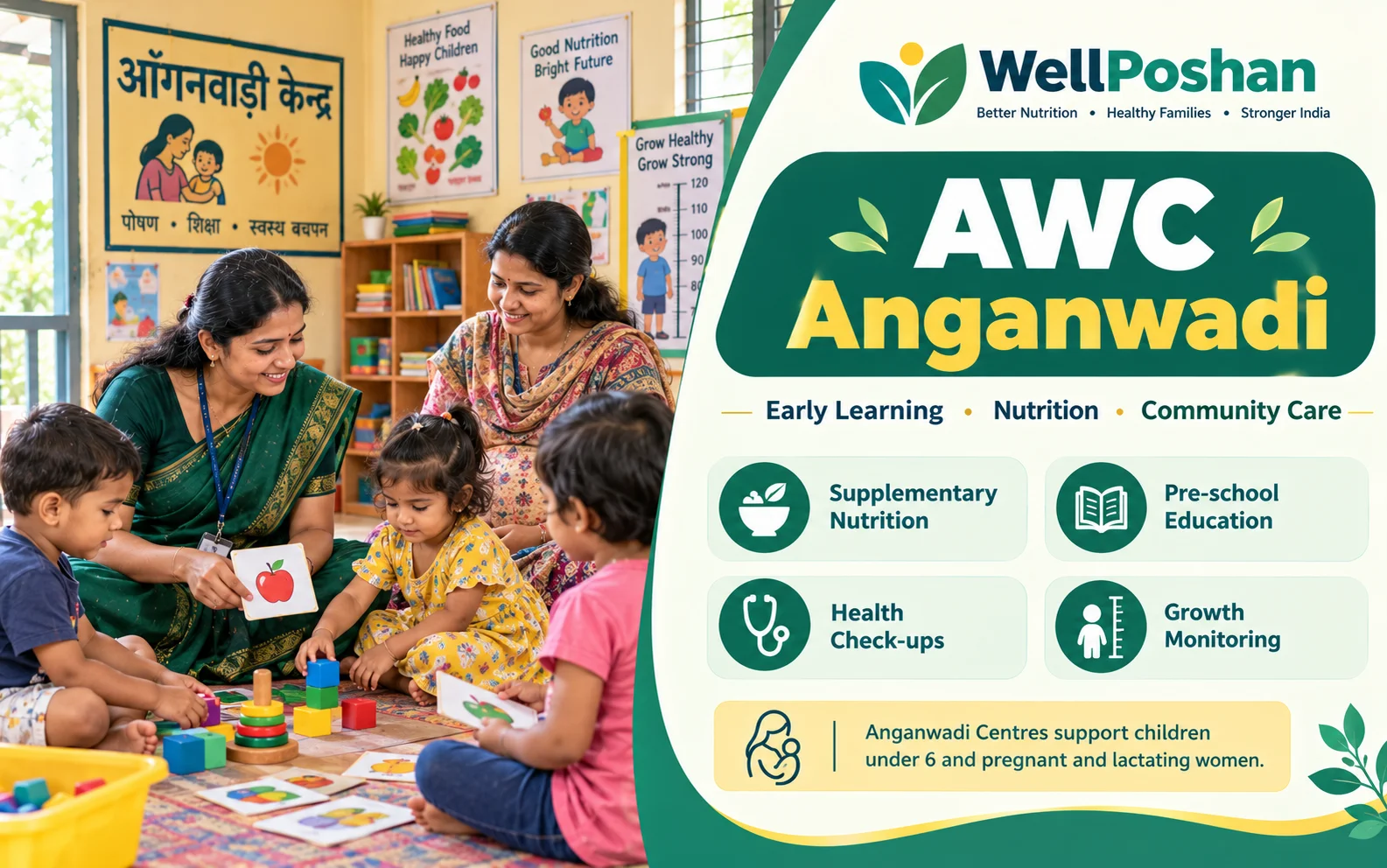
AWC stands for Anganwadi Centre. It is the village- or ward-level unit of India’s Integrated Child Development Services (ICDS), now run under Mission Saksham Anganwadi and Poshan 2.0. So “AWC Anganwadi” and “AWC in Anganwadi” simply mean the same thing: a local Anganwadi Centre staffed by an Anganwadi Worker (AWW) and an Anganwadi Helper (AWH).
AWC Anganwadi at a Glance
AWC Anganwadi Full Form and What an AWC Actually Does
AWC Anganwadi full form: Anganwadi Centre. “Anganwadi” itself comes from the idea of a courtyard shelter. The centre is meant to be the first point of contact for health, nutrition and early learning in a settlement.
A standard AWC serves:
- Children aged 0 to 6 years
- Pregnant women and lactating mothers
- Adolescent girls (the scheme targets ages 14 to 18 in aspirational districts and the North-Eastern Region)
The core services are supplementary nutrition, pre-school (non-formal) education, nutrition and health education, immunisation support, health check-ups and referral services.
How many people does one Anganwadi Centre cover?
Under ICDS population norms (Ministry reply, Lok Sabha), one AWC is sanctioned for 400 to 800 people in rural and urban projects, with two AWCs for 800 to 1,600 and so on in multiples of 800. Mini-AWCs were meant for hamlets of 150 to 400 people, and tribal, hilly or desert areas use lower thresholds (300 to 800 for a full AWC). The government has since decided to upgrade mini-AWCs to full centres with a worker and a helper.
What is a Saksham Anganwadi?
Under the 15th Finance Commission cycle, 2 lakh AWCs (40,000 a year) are being upgraded into Saksham Anganwadis with LED screens, water purifiers, Poshan Vatikas, early-childhood materials and “Building as Learning Aid” paintings. The Lok Sabha was told that 1,03,940 centres had been upgraded as of 13 March 2026. Rajasthan has 3,514 centres approved for upgrade, according to a 24 July 2026 Lok Sabha reply reported by Kashmir Life.
AWC Anganwadi Odisha 2026: Is There a Single Notification?
No. This is the most common misunderstanding. Odisha does not publish one statewide AWC Anganwadi 2026 notification. Vacancies are advertised centre by centre and block by block, by the Child Development Project Officer (CDPO) or district office, and applications run through the state’s engagement portal, engagement-awc.odisha.gov.in.
That is why you will see many small, overlapping “2026 notifications” online, each covering one to a dozen posts. For example, a notice reported in October 2026 (notification dated 6 October 2026) covered a single Anganwadi Worker post in Bijepur with applications open from 9 to 23 October 2026. Other windows earlier in 2026 covered Bhadrak, Sambalpur, Sundargarh and Jagatsinghpur. Treat any aggregator page as a pointer, then confirm dates and vacancy details in the actual PDF on the portal, because several aggregator pages show mismatched notification dates.
Eligibility (Anganwadi Worker, Odisha)
The Odisha WCD department’s revised selection guidelines set these anchors:
- Minimum qualification: 12th standard pass
- Language: knowledge of Odia is required
- Merit basis: percentage of marks in the 12th examination
- Residence: the candidate should come from the area served by the AWC (adjacent villages within the Gram Panchayat can be considered under the rules)
2026 notices summarised by job portals also commonly state a 18 to 35 age range counted as on 1 January 2026, with relaxations as per Odisha government rules. Because age limits and relaxations are written into each notice, always read the PDF for your centre.
Step-by-step: how to apply
- Open engagement-awc.odisha.gov.in and find the event for your district, block and AWC.
- Download the notice PDF and confirm the centre name, post (Worker, Mini Worker or Helper), dates and category reservation.
- Check you live in the catchment area the notice names.
- Register, fill the form and upload your photo, signature, 12th mark sheet and residence proof.
- Save the acknowledgement. Merit lists and document-verification dates follow on the same portal and CDPO notice board.
A simple “3-check” method before you apply
Aggregator sites often copy each other, so use this filter:
- Portal check: is the event actually listed on the engagement portal?
- Notice check: does the PDF name your exact AWC and the same dates?
- Residence check: does your village or ward fall inside the area named?
If any of the three fails, the application is likely to be rejected regardless of your marks.
AWC List: How to Find the Right One
“AWC list” can mean three different things. Pick the one that matches your need.
AWC List Rajasthan
Rajasthan has 62,010 sanctioned Anganwadi Centres, and Parliament replies have recorded roughly 61,900 as operational (61,974 in 2019 to 2021 data, and 61,869 in a December 2023 reply). The state’s Women and Child Development department publishes notices at wcd.rajasthan.gov.in, and centre-wise vacancy lists are usually displayed at the respective CDPO office. A 2026 district-level notice, for instance, was reported to list 34 Worker and 71 Helper vacancies spread across 12 CDPO projects, which shows why you should look at project-wise lists, not a state total.
AWC List Odisha
Odisha has 74,154 sanctioned centres in the Ministry’s data. A statement by the state’s Women and Child Development Minister, reported by The Statesman, put functional centres at 74,224, of which 54,074 had their own building and 20,150 did not (construction of 7,389 was under way). The same report said 10,416 mini-Anganwadi Centres had been merged into main centres. Note that Odisha’s numbers vary slightly between sources because of mini-Anganwadi Centre mergers and reporting dates.
Honorarium: What an Anganwadi Worker Actually Earns
AWWs and AWHs are officially “honorary workers”, not regular government employees, which is why Parliament replies describe their pay as honorarium rather than salary. The central rates were last revised on 1 October 2018.
Worked example (Odisha, main AWC, using the Parliament figures):
Two cautions. First, state top-ups change, and some job portals quote a much higher Odisha total (around ₹10,000). That does not match the Parliament annexure above, so confirm the current rate in the latest state order before relying on it. Second, the incentive depends on performance linkage, so do not count it as guaranteed.
Beyond pay, workers are enrolled in insurance schemes (PMJJBY and PMSBY, as described in Ministry replies), and 50% of Worker posts are to be filled by promoting Helpers with five years of experience.
Common Mistakes and Misconceptions
- Confusing the centre with the worker. The AWC is the place; the AWW is the person.
- Assuming a statewide exam. Odisha selection is merit-based on 12th marks, not a state-level written test.
- Reading “sanctioned” as “functioning.” Sanctioned counts are approvals; operational counts come from Poshan Tracker.
- Trusting old notice pages. Many pages with “2026” in the title reuse older notification numbers.
- Missing the residence rule. Applying for a centre outside your catchment is a frequent cause of rejection.
How Anganwadi Centres Are Monitored Now
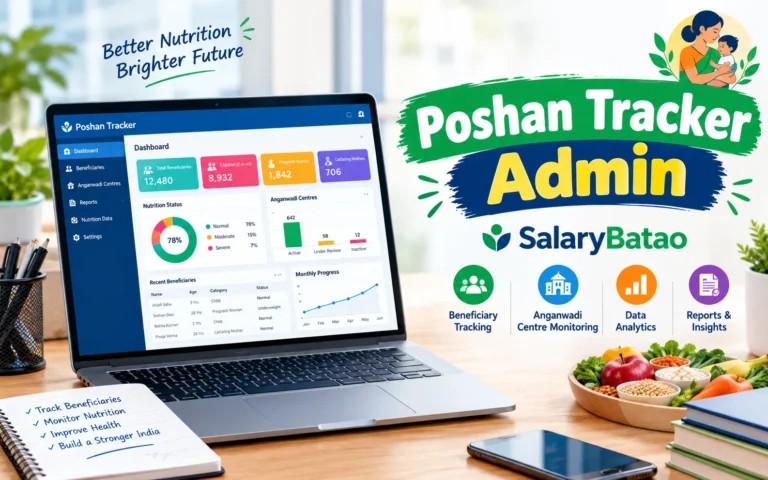
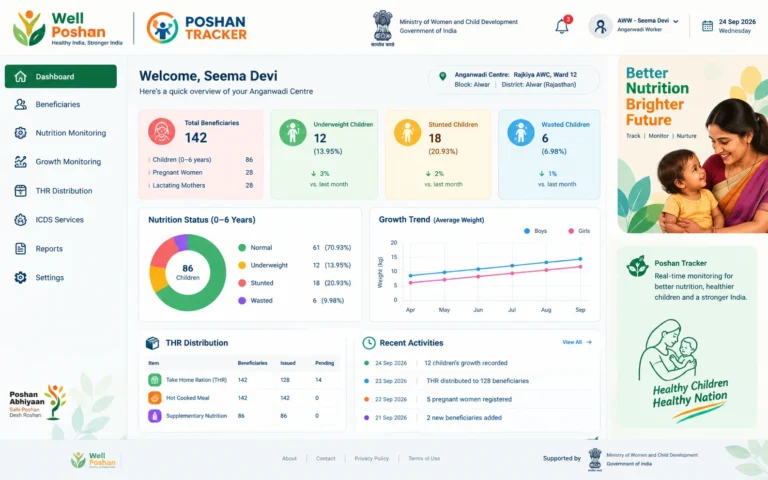
Anganwadi workers record services in the Poshan Tracker app, which digitises the paper registers. It also has a Nominee module so a beneficiary can receive Take Home Ration through someone else, and the Ministry has said services are open to anyone willing to complete e-KYC. For families, this is the practical reason an AWC’s code and location should be correct in the system.
FAQs
Is an Anganwadi job permanent?
No. Workers and Helpers are honorary, engaged locally, and the Ministry has said these functionaries cannot be regularised as government employees. Promotion from Helper to Worker is available after five years.
Can I apply to an AWC outside my village?
Usually only to the centre area named in the notice. Odisha’s rules favour local residents, with adjacent villages in the same Gram Panchayat considered in specific cases.
Where can I find the exact AWC near me?
Start with your block’s CDPO office or the district website, then verify on the Poshan Tracker dashboard. Centre codes and locations are mapped there through Local Government Directory codes.
Does the central honorarium differ for a mini-AWC?
Historically yes (₹3,500 versus ₹4,500 for a worker), but the Ministry has ordered mini-AWCs to be upgraded to regular centres, and the Ministry has stated that existing mini-AWC workers’ honorarium was raised to ₹4,500.
Do I need a coaching course to get selected in Odisha?
The Odisha guidelines and 2026 notices describe selection by merit list from 12th marks plus document verification, not a written exam, so there is nothing to coach for. Always confirm in your own notice.